Sunday 21 May 2023 – Day 81 (21 of writing) – 5.30 am
Part 3 of why I advocate for family voice in the disability world
Just like that I stopped writing for 3 weeks. I have to say it is just part of the territory when raising a complex child. It is hard to stick to and complete projects. However, I have learned that something is better than nothing, and continue to try out projects like this, on the proviso that I don’t beat myself up when I don’t fully complete it. Like all things related to our journey as parents – you ‘just do the best you can”.
Later today, I will be flying to Christchurch with 3 of my colleagues to attend a conference for the Federation of Disability Information Advisory Services (DIAS). As the name suggests, DIAS provide free and independent advice to disabled people, their families, whanau, aiga, caregivers, providers and the general public.
Sunday 04 June 2023 – Day 95 (22 of writing) – 10:42 am
And just like that I stopped writing again – I’m back from Christchurch and now looking forward to going away on a holiday with Phil to Singapore and Thailand (later this week). But I shall carry on with my thoughts on why I advocate for family voice. I finished my previous post when Mitchell was just starting out at school – 13 years ago now.
At that time, we discussed with the Deputy Principal whether Mitchell would be funded with the Ministry of Education using ORRs – as high needs or very high needs or whether he would receive a different type of funding called High Health needs. I viewed Mitchell’s needs as ‘health’ related and still hadn’t moved into a space of calling him disabled. I was still not sure whether Mitchell being unable to talk was related to the tracheostomy and he was labelled as having ‘global developmental delay’. Phil and I believed, and still do, that he understood what was going on around him, but he just couldn’t articulate or communicate it back to us. Maybe I was in denial of the possibility that he had intellectual disability, but it didn’t seem important to put a label on it – it just seemed more important to try and give him as many opportunities as we could.
Choosing to send him to go to a ‘special school’ was a tough decision. As parents, it’s a brutal acknowledgement that your child is not fitting the concept of ‘normal’ and that community has a long way to go to accept difference in terms of both physical and intellectual disability. It’s not just a tough decision, it’s crushing. It’s isolating for both the child and the parents and it’s a realisation that you will never have the life you dreamed of as a mother, watching your child play sport, give a speech, bring friends home to play or tell you about what they did at school that day. You are going to have to trust and rely on those working to support him to find out what happened at school that day, and what progress he is making, whether he is hurting or how he feels.
This was a major step, that we were not ready for. He was going to attend school with a tracheostomy in place, and some days he would be attached to an oxygen bottle. We needed to ensure he got the most support hours we could, and that it would be someone dedicated to his care. His safety was of the utmost importance – we had been told that a person trained in trache cares must be with him at all time. If his trache tube came out, and he was left alone, unable to breathe, we had minutes to get it back in, or the result could be fatal. Although we felt that his highest needs were ‘health’ related, the DP suggested we apply for Very High Needs ORRS funding. we were given forms that asked us to tick boxes – many of them not relevant – is he blind or deaf? These didn’t apply. But it didn’t seem to ask questions that were relevant to his needs. Where did it ask if he could breathe on his own? I was told that the Very High Needs category was ‘hard to get’ and that the reality of it was that he would not get a one on one Teacher Aide, it would be more likely that he would receive enough funding for a teacher aide to be shared with one other person. I was flabbergasted – here we were expected to send him off to school with a disregard to the level of his needs.
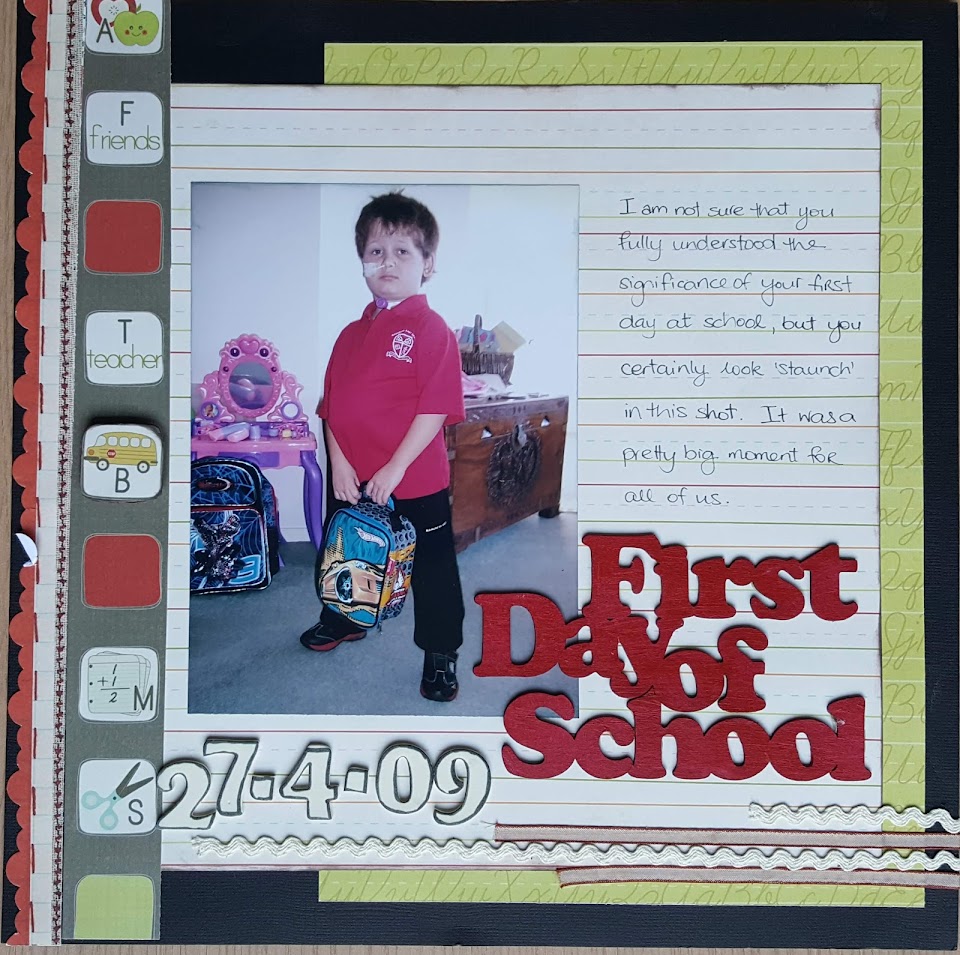
Mitchell started school on 27 April 2009, aged 5 years and 4 months.
This assessment we were given would be given to someone to make a decision about how much support he could have. Did they even know what Pentalogy of Cantrell was? Did they understand the consequences of a trache becoming blocked, or what lack of oxygen was going to do to his brain? I had little to no confidence in the system. But it is the system you have to use, and we ended up being granted high needs funding. Our friendly DP at the time, assured me that although he did not get Very High Needs, he would not be without. The school also had funding that they would use, there were many students also, that didn’t come to school every day, and this enabled resources to be shared and go further. I would find out later, that we would also be one of those families who contributed to this, as Mitchell took many days off sick.
Something that was never explained to me back then, was that if you get very high needs ORRs funding this will then carry on past the end of school life, into funding that is transferred to MSD for vocational use. Thankfully, we went down this path, which will make a small difference to funding for life after school – which is now approaching very fast.
Now, if another parent asks me about which is ‘better’, although I can’t say which type of funding would suit their child, I do understand that your decisions make long term differences. The last thing on your mind, when your child is transitioning in to school, is what will life look like as they transition ‘out of school’ 16 years later.
 Yellow Azalea
Your scrapbooking pages look lovely. I hope you found writing your blog post therapeutic. Sometimes it feels good just to get everything in your head onto the page.
LikeLike
Thanks Laura. I’m not scrapbooking as much these days, but I need to get back into it, as I like looking at the memories.
LikeLiked by 1 person