Today, our family will have our annual needs assessment review with Taikura Trust (the Auckland Needs Assessment Service Co-ordinator – NASC). Mitchell receives funding for his ‘disability’ needs via this assessment. We also have an assessment with the Long-term supports – chronic health conditions (LTS-CHC) team to review his ‘health’ supports. Although, I have reached out to our LTS-CHC co-ordinator, I have not yet had a reply and we have 3 weeks left until our current budget will expire. Every year around late May, early June, I agonise over this process. Will we be able to continue to pay support workers after 14 June (expiry date) and will we receive enough funding to continue to keep Mitchell at home? This year, as he leaves school, we also have to plan a new life in the community with him.
My emotional state is always heightened as I prepare for his needs assessmetnt – this year, I am particularly concerned – I live in fear that the support we receive will be reduced. It’s worse than ever this year, as not only will Mitchell finish attending Rosehill Special School, his respite option at Wilson Home will also finish as he turns 21 years old. On top of that, we have a coalition right wing government who have just restricted the ‘way’ we can use the supports we receive – this has diminished our options.
School Hours
His current supports via Individualised Funding do not provide support time for the hours of 9-2.30 pm as these are the hours he attends school – and this is funded out of the Ministry of Education (MOE) budget. Via the MOE, he has what is called Very High Needs (VHN) funding – this funding is provided to a limited number of students with the highest needs and paid to the school they attend and provides his Teacher Aide salary and because he attends a special school, he has access to a Speech Language Therapy (SLT), Physiotherapist (PT) and an Occupational Therapist (OT). He should also have a Psychologist, but this has been missing in action for some time.
In yesterdays budget there was no hint of additional learning support needs funding for mainstream schools or an increase in ORRS funding – it remains as capped expenditure. There is no additional funding for early intervention support or therapists at mainstream schools.
When he leaves school this year, that funding (around $24,000 pa) is transferred to the Ministry of Social Development (MSD) for him to access day programmes or services offered by providers. Mitchell requires one on one support and supervision at all times – just the cost of this (25 hours x $37 ph x 40 weeks) is $37,000. Then there are the 12 weeks, that are normally school holidays, which is a another 12 weeks x 25 hours x $37 = $11,100. This is just the cost of one extra employee, who is paid the Level 4 Health and Wellbeing pay equity rate of $28.25 – $29.10 per hour ($37 is the cost of an employee at this rate, when you add holidays, sick leave, kiwisaver etc). One support worker for these hours is close to $50,000 per year. But the government funds an organisation $24,000 per person to do it all.
Sure, not everyone needs one on one supervision, so how providers work, is that they will take into their progammes those with the ‘lowest needs’ of the very high needs, this way, they can provide care for say 3-4 disabled people using one support worker. Under this system, it is unattractive and unsustainable to have the highest needs people join. There is no incentive to have those with the highest or most challenging needs – so it is only when you have an organisation who is ethically aligned that you have a chance of finding a great option. A provider can supplement the government funding, by charging the person/family for the programme and for additional activities they provide. Usually the additional money comes from Individualised Funding (Respite) or Carer Support funding (Respite). For adults with intellectual disability, who may have minimal opportunity to be employed, day programmes/services are often the only affordable and realistic options out there, unless families can find innovative ways to start a micro-enterprise and/or negotiate to receive funding to support a different pathway in the community.
In yesterdays budget there was no increase in the MSD/Disability funding that addresses this. There was an increase that will keep up with the cost of living and the cost of keeping the restrictive system going, but there was no relief in sight for families.
PLUS, day programmes have no Therapists – so the family then becomes responsible for accessing therapy via the Health system. Waitlists for this are long, there are no regular ‘therapy’ sessions unless you go private, there is no-one to teach new support workers how to use an AAC Device, communication with a non-verbal person, how to keep your adult child fit and moving – except for the parents. The parents are then responsible for finding a way to pay for these services, or their adult child simply goes without.
In yesterdays budget there was a substantial increase in Health funding, but I couldn’t find any detail about whether the shortage of allied health services – SLTs, OTs, PTs were going to be increased?

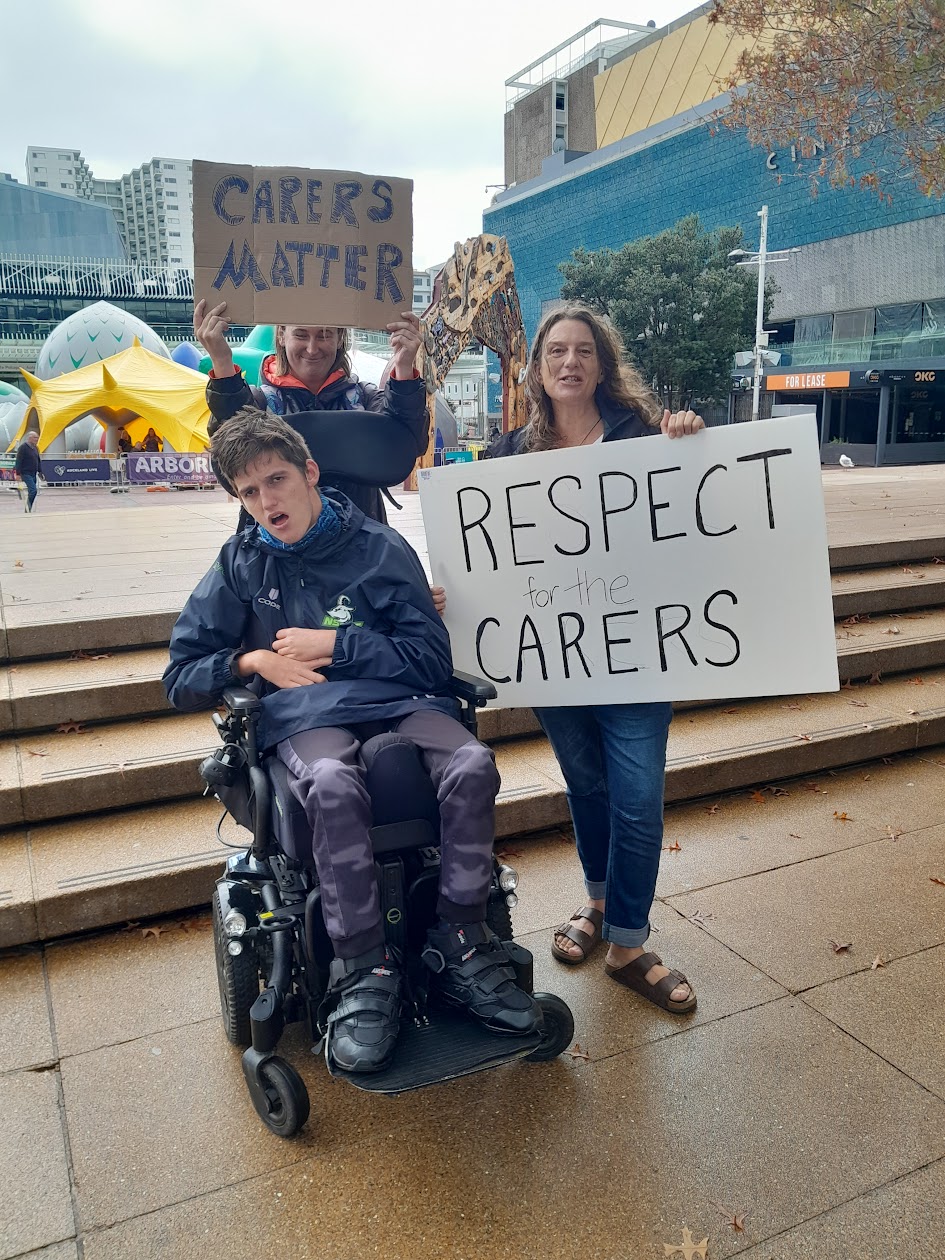
Friends at one of the recent Auckland Protests about funding restrictions
Respite and wellbeing for family
This year our son’s Facility Based respite at Wilson Home finishes as he turns 21 years old. There are no adult facility based respite options available due to his complex needs. Right now he spends 3-4 days per month at Wilson Home. The suggestion and alternative available is to send him to aged residential care for a break. Respite should benefit both the family and the disabled person and this does not fulfil that requirement and is an insulting suggestion that this is what is available. The reason we use FACILITY based respite is because our son uses oxygen therapy, is NG tube fed, has complicated medications and uses APap support (previously he had a tracheostomy and BiPap). These medical interventions require nursing level care. While at home, we don’t have nursing qualified support workers, because, we (the family) assume the risk of doing these duties or supervising care workers to do them. A government based facility will not take this risk unless they have medical staff on their payroll.
Instead of facility based respite, we will now have to create our own respite solution. Yes, we do both still need one. We need breaks from each other to stay healthy and to build resilience to keep going. We need breaks, because in our house there is no night and day. Sleep issues mean our son can be up all night and sleep in the day, behaviours are challenging and life is not smooth. Instead of paying a contracted provider, the government will reassess our respite option under IF and give us the paltry sum of approximately $200 per day for respite to include overnight care. THIS does not even pay for one person for 24 hours ($37 x 24 hours = $888). This is not for a nurse, so this means if I am a responsible parent, I should not leave my person alone with the care worker as they are not qualified for this work and it puts my son at risk. So, I should not leave the house for a break. As a parent, if you have ever tried to take a break from your children while in the same space, you can appreciate that it doesn’t happen – children (especially children with a disability like autism) will gravitate to their parent. There is no break for the parent in this situation. It is not respite. Alternatively, we could pay a nurse via an agency using the $200 and possibly get 3-4 hours of care. Now, before your child reaches 21 years of age, and respite is available at Wilson Home – the government is willing to pay them for 24/7 nursing care (one nurse to about 5 people and then 1:1 or 2:1 care workers), pay the overheads of the facility, the meals and possibly even the transport to the facility (we have not had this option). Who picks up the shortfall – the FAMILY. Who doesn’t now get a break – the FAMILY.


But, FAMILY is expected to continue to support this person until either they die or their child dies. And family do, until they can’t. Usually, because they are broken or unwell themselves and the care of the person reaches a crises. At the point of crisis, a solution is found. It’s not always a great solution, but it will be a solution that costs a lot more than what the family received to keep their family member at home. And this solution will cost the taxpayer a lot more money than what the cost would have been to support this person and their family in an environment that has love and comfort for the complex disabled person.
In yesterdays budget there were increases in funding for residential care and community support services to maintain the cost of existing support. There was no sign of capital expenditure for respite based facility for complex high needs around the country, for children or adults.
Disability Rights
In line with Disability Rights and the United Nations Convention of Rights for People with Disabilities (UNCRPD), which the NZ government signedin 2008, there are rights for Disabled people to live with ordinary life outcomes. Ordinary life outcomes include being able to leave home as an adult, go to work, use transport, be able to eat, be able to have a social life. Ordinary life outcomes are not extravagant outcomes, just simple things that are often denied to those with a disability.
When the complex disabled person is not funded adequately with support they can not achieve ordinary life outcomes. They have limited choices. They are more likely to live in poverty. Of the 50,000 people receiving disability support services in New Zealand, 42% of these people have an intellectual disability. Many have multiple disabilities. Some, like my son, hit the jackpot and have intellectual disability, physical disability, autism, a rare disorder and health complications. While he doesn’t have a sensory disability (blind/low vision or hearing problem), he is non-verbal and is sensory averse to certain things. He is not in a position to advocate for themself, he can not vote, because he can not write. He is excluded from many aspects of community, and can not scream and shout at the politicians to listen and act responsibly. That is why I do.
The result of the yesterdays budget
Yesterday the budget for Disability Support Services for the coming year was increased from 2.2 billion to 2.5 billion (approx). On the surface it looks like a win – 300 million more this year. But, it is not a win. It is a number without substance. While the coalition government conducts its review of Whaikaha, disabled people and families are struggling, going without respite, feeling anxious, getting deeper into depression.
- Disabled people are hurting while they sit on waitlists for repairs to their equipment.
- Children are on long waitlists for communication devices.
- Parents continue to pull children out of school to homeschool as the education system does not support their learning needs.
- Familes go without breaks, and their mental health declines
- No investment is made into facility based respite for complex care
- Purchasing of items to support disabled people is on hold via respite
- Day services are underfunded and full
- Complex adults are pushed towards entering aged residential care (over 800 currently)
- Families who provide ‘natural support’ to care for their young and adult children receive no tax cut because their work is not recognised as work.
On the 18th of March, this coalition government devalued carers (mainly women) by taking away the flexibility in respite options. They devalued the work we do, whether you are a paid or unpaid family carer by making a short-sighted decision to remove flexibility. Families and Disabled people did not ‘overspend’ the budget, the Ministry underestimated the need. The Ministry is not creating or looking at data that would show there are more complex disabled people living now in the community, there is a growing number of people with autism, the disabled population is bigger, the ethnicity demographics are changing and there are not enough health and/or disability services to keep up. They have ‘budgeted’ on a budget not being used in full by Individualised Funding users, and when people used the specific funding they were allocated based on need, they turned the problem they created into a nightmare for disabled people and their familes and carers. The government and comments made by Penny Simmonds before she left have damaged the reputation of carers and dismissed the value of disabled people in society.
I can’t congratulate this government on delivering tax cuts when it comes at the cost of demeaning carers and reducing human rights for both disabled people and their families. If only, my son, could be fully supported now 24/7 with qualified and appropriate support in a home of his own, both my husband and I could return to work full-time. Perhaps then we would return to being considered everyday working New Zealanders who add value to the economy, because that seems to be the only thing that matters. The small amount of tax reduction I personally received will go towards the $20 rent increase that starts next week. How ironic to receive a rent increase at the same time as a tax reduction! For years, we have been ‘caring’ out of love – this is not the same as parenting.
Caring for us is:
- Being on call 24/7
- Doing personal cares (changing nappies, bathing/showering, feeding, brushing teeth etc)
- Giving multiple medications
- Attending appointments
- Preparing blended food
- Multiple trips to hospital, sitting in ED for hours and hours
- being hypervigilant always – making sure things don’t get broken
- Not having a day or night
- Recruiting and employing support workers – paying their wages, dealing with training
- Advocating in a broken system
- Driving around and around and around to help my son self-regulate
- Never being able to plan without first having to confirm a support worker
- Canceling social life because you can’t make it ‘again’
- Becoming isolated
- Not getting reciprocation from the one you love
- Losing faith in a system that doesn’t believe you when you explain what is happening
- Always being the ‘fill in’ person when a support worker cancels
- Interpreting all of his communication
- Not being able to spend the amount of time you want with your other children
- Packing a lot of stuff to go away or leave the house
- Learning how to do therapy and use machinery that nurses/doctors use
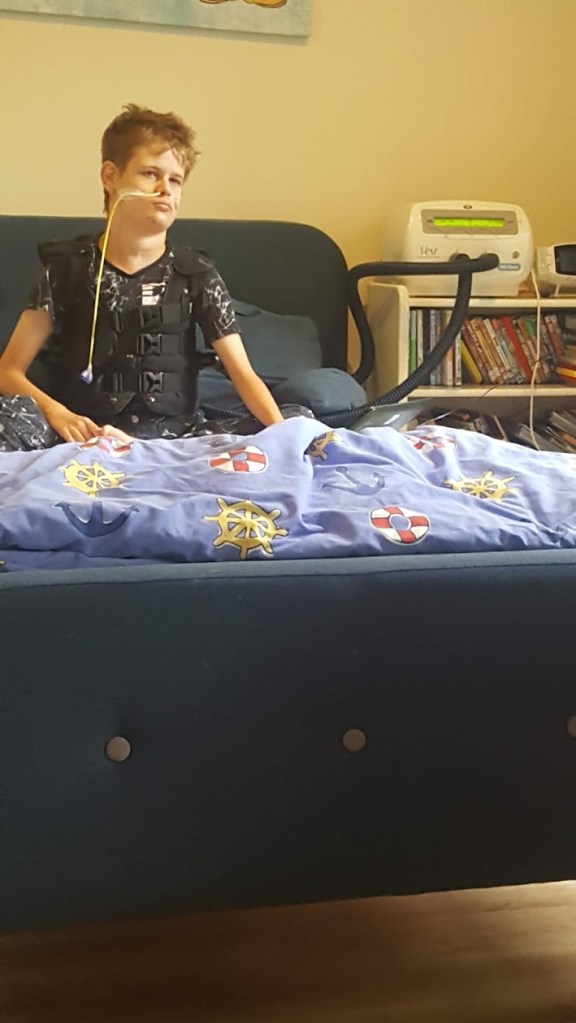


Caring for us is done because we love our son. Because he is worth it. Because there is a fear that if we didn’t do it he would enter into a system where he is susceptible to abuse, where his needs are not met because no one understands him. Because the alternatives put him at risk.
At 11 am today I will advocate for my son, as best I can, with the energy I have left, so that he receives support to live his best life. But I’m scared for what the future holds, when we have a government who only believes those in the middle are the ‘everyday working people’.
Disabled People and their families and carers have been denied the right to a good life for too long. Families like mine, supporting a person (or sometimes more than one) with complex needs are hurting from the restrictions this government has imposed. A government who wants to deregulate business and rules around landlords yet finds it necessary to return to prescriptive and regulated funding for disabled people and carer respite.
I implore the reviewers of the system to look at more than the numbers on a spreadsheet like the government is doing. Behind those numbers are people like us – people who are still valuable members of society that are being made to feel like they are an impediment to society and the economy.
Cherie
 Yellow Azalea