Today I want to talk about what it means to ‘carry the load‘ for a complex caregiver. I have been motivated to write about this as I continue to see the role of women in caring roles being devalued by our current government. While there are some men who are the primary caregivers of those with complex needs, and although I am unable to give an quantitative statistic due to data that is not deemed necessary to collect, in general it is believed that over 80% of family carers are women.
Carrying the load is a phrase that is used metaphorically to mean bearing responsibility or burden, often in a challenging situation. The load you are carrying can refer to physical, emotional or mental burdens and in a western context is often used figuratively to describe a person who has a lot of challenges or work to carry on their own.
In today’s terms, a complex caregiver (mother or father of a child or adult needing intensive support) will often carry a much larger load than a parent of a child with ‘average’ needs, and for a longer period of time. This ‘load’ often results in caregiver burnout if there is not enough support around the person they are caring for and the support or breaks they need to carry the load are not available. It’s difficult to compare physical, emotional and mental loads and the toll they take, but they all have an impact.
Physical loads:
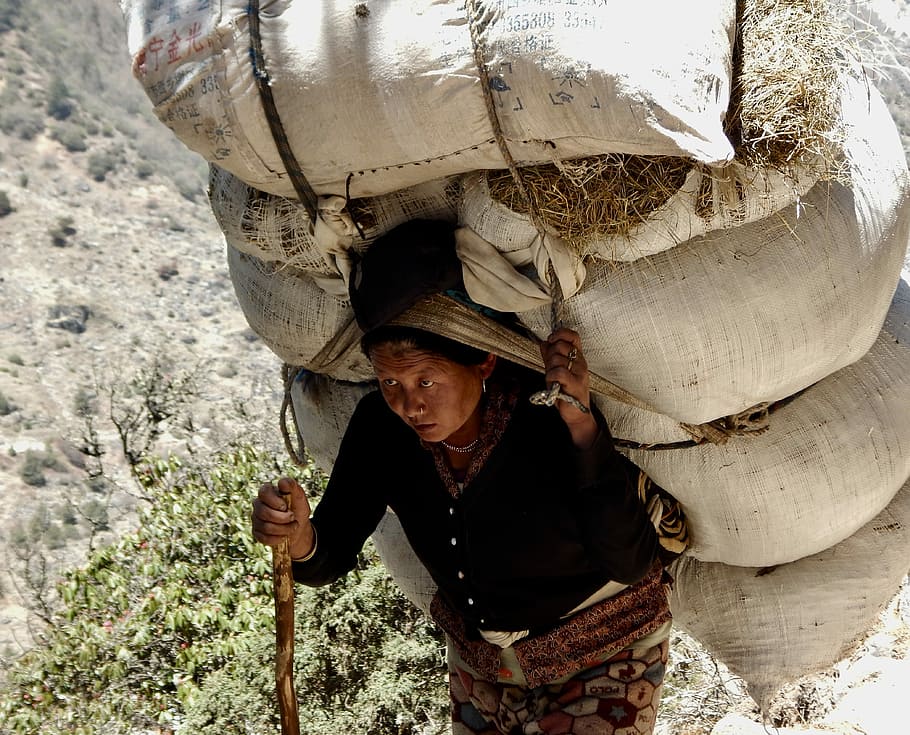
In developed countries, we are often aghast when we see pictures of women in the African or Asian Continents carrying heavy loads on their backs or heads in agricultural settings.
Women (or men) would not be expected to lift and carry a load like this here in NZ. In fact, there are usually stringent health and safety regulations to ensure this does not happen .
But are we really that much more advanced? Sure, baggage handlers at the airport, warehouse workers and those employed in large organisations and enterprises such as hospitals, schools and in residential care homes are restricted to a limit of what they can lift in weight. This helps prevent accidents, and limits injuries caused by the lifting of heavy weights. Worksafe recommends that women do not lift more than 16 kg and this is when the lift is done correctly – holding a weight close to your body around waist height. Why, then do these weight restrictions not apply in our homes when we are lifting and caring for our heavier children or older adults? Why is it then, that home carers are not provided with equipment and/or additional support in order for them to prevent injuries? Why is the predominantly female home care workforce overlooked when it comes to lifting, rolling or picking up their child or spouse?
I know of many families, where the Mum carers (some who are paid carers, some who are ‘natural support’) are lifting and managing weights far in excess of what is considered safe. In our home, while my son at 21 years is still only around 50kg, he still sometimes requires to be lifted or assisted in or out of the bath, car or off the floor. Plus you can add a level of ‘uncooperation’ into the mix and that weight is far more than what is safe. While I am grateful that he isn’t 100kg, I still struggle (as do our paid caregivers) to manage to lift or maneouver him when he is too tired or unable to do it himself. But there is not a choice when he parks himself on the ground in the middle of the road or a carpark, or in the pool when it’s closing and he doesn’t want to leave. So, we do it. We lift a load that is way too heavy and this often comes at a risk to our own health.
In a recent discussion with a Mum of a young lady, she told me that at school her daughter requires 2:1 lifting from her wheelchair. She is now coming into a Te Kura schooling situation due to inadequate provision of help in school. The Ministry of Education will not supply 2:1 or allow the single Teacher Aide (TA) allocated to lift on their own at home. The government funding doesn’t stretch to this and MOE think DSS should pay for it. Yet, this work still has to be done, and guess who has to do it – the Mum. How inconsistent the regulations are and how many loopholes have been created by making parents of complex children and adults the Employer without the support that is needed to do the work safely. I am a supporter of the Individualised Funding scheme but this agency/parent responsibility as an employer loophole is getting pretty tired.
We have to question, what the long term impacts of this ‘lifting of physical loads’ will be. As we see more and more complex disabled and/or chronically ill adults living at home how will the data around accidents and injury of home care workers and parents be collected for those who are having shoulder, back or other injuries because of their care responsibilities? We really need to speak out about this problem because my bet is that the data on this is falling into a black hole.
Mental and Emotional Loads:
As stated before, it is difficult to compare physical to mental and/or emotional loads we carry. It’s not a quanitative measure in many respects. Carers New Zealand do their best to measure wellbeing in their regular surveys and this is probably the best and most recent indicator we have of how well carers are coping with mental and emotional loads. In the State of Caring report (2022) by Carers NZ and the Carers Alliance, 84.3% of respondents were women and 70% of the carers indicated high levels of depression and anxiety, compared to 20% across New Zealand’s general population over the same year period.
Personally, I am not doing well. This past 18 months have really taken a toll on my mental and emotional health and because of it I have ‘shifted’ much of my load to my husband. We are trying our best to ‘share the load’, but that is not easy either. Currently, I am handling the paperwork, recruiting, supplies, finding social activities, appointments and staffing, while he is more actively hands on with the physical caring. We are both thinking and mulling over the next steps and that never really leaves either of our minds and always leaves me in a sense of overwhelm and despair.
What do I mean by a mental load anyway? For me it is the logistics of managing what I call the business of Mitchell. This is making sure I get timesheets for 5 carers done on time, that payroll is accurate, that I am following employment guidelines, that I chase up the consumables when they are wrong, that the chemist fills the scripts correctly, that expenses are paid out, that I will be able to pay for what we need. That I am advocating for Mitchell. That I am advocating for myself and my family. That I complete needs assessments, chase needs assesments, figure out which person I have to talk to for what. For example, last week alone in organising medication for our son, I was exposed to 3 separate errors – one from the psychiatrist (4 days after requesting hasn’t sent the script to the pharmacy), the GP who sent the wrong dosage for a anti-psychotic medication to the pharmacy (even after specifically telling the call centre which dosage was required) and the pharmacy who when picking up the script left one behind in the fridge, which meant going back to the chemist for the 3rd time in 2 days. This stuff is tiring – I am NOT the paid professional here in this circumstance but it is up to me to check and double check the professionals get it right?
After 20 plus years I now know my way around ‘the system’ but that also means I have carried the chronic stress in my body for a long time now. While I make an effort to look after my own wellbeing as best I can, it still is a large load to carry inside my head. If I was a mother who was not also a ‘complex carer’, my mental load would have decreased over time as my child’s capability and independence increased. This transition does not happen when your child requires intensive support. It stays with the parent or guardian.
The business of Mitchell has changed from when he lived in hospital, to when he went to school to now. Now, when he is home full time and we are still trying to find options suitable for his version of adulthood. If only, the services would answer the emails and provide the supports we need and desire, then perhaps the mental load for me, could be just a little less.
I would love to manage without the assistance of welfare options – but when you can’t go out and work full time because of the needs at home – your choices of ways to earn money are restricted and in our case this has not become easier as Mitchell has grown up. Reaching an age does not equate to reaching a developmental stage. So here we are in New Zealand – carrying the Mental load of where to go for what and just trying to fill out the right form to get the support our child needs. It doesn’t look too different to the first women carrying the hay bales does it?

The mental load of organising on a day to day, week to week, month to month, year to year basis is gruelling.
How about the Emotional Load?
We all have a basic understanding of emotion right? You can recognise easily the 4 basic core emotions – happiness, sadness, anger and fear. But there are hundreds of emotions to feel and put names to – there are any number of resources out there if you want to dig deeper into working out what emotions you might be experiencing. These days I often live in an angry state – sometimes it’s suppressed anger, sometime it boils over, and even becomes rage. I’m not proud of it – but when it all gets too much, I get angry. My current read, Rage Becomes Her, highlights just how angry women are and why they feel they need suppress their anger.
But when I refer to Emotional Load I am not just talking about the core emotions that rise and fall. It’s the delicate emotions like guilt, shame, worry, anxiety, dread, frustration, despair, grief and disappointment that build over time that are what creates the emotional load. The constant questions in my head about:
- Have I tried hard enough to be inclusive? (guilt)
- What do my friends and family think of my parenting and how I give in? (shame)
- What will happen when I die? Who will care for him like I do? (worry)
- Am I going to get pinched or kicked today when I try to do the personal cares? (anxiety or fear)
- What mess will I find when I wake up in the morning? (dread)
- Why can’t the system see how hard it is and help with more supports? (frustration)
- There are no solutions, I just have to live with this (despair)
- Why couldn’t I have had a healthy child? (grief)
- Where are the people to help? Why did the government change flexibility? (disappointment)
The emotional load and in particular whether one has ‘done enough’ and the fear around what will happen if and when you are gone are huge and most parent’s greatest fear. When your child is complex and has limited communication and intellectual capacity they are very vulnerable. This emotional load is not only a female issue, but it is largely a load carried by the primary carer, and most often in two person heterosexual relationships, this becomes the mother’s role and who society places the expectation on.
All of this brings me back to my grave concern for women who provide the majority of the care work, who are being mistreated by policy and legislation because we become silenced at the shame of speaking out about what is historically been a gendered role. It’s why it hurts so much, to hear messaging from MPs signifying that only those in ‘paid work’ are valued by taxpayers.
It’s why the 17 June facebook post from the Minister for Women, infuriated me recently, when she held up and praised a ‘dog’ called Griz, for working hard and contributing to the economy. It seems that dogs are more respected than women. Even the fact, that the dog in the post is a ‘he’ sends out a subliminal message. Don’t get me wrong, dogs are great and I support that agriculture is important for our economy. But let’s get real here – why is the Minister for Women not being vocal around the Pay Equity cancellation? Where is the voice for women in care roles who work 24/7 looking after adult children with complex disabilities? Take a look at the post our Minister shared here.
I have rewritten how it could have been.
“This is Grizz. Cherie
GrizzCherie is a New Zealandfarmer.Mum of an adult son with intensive care needs.Like most New Zealanders,
GrizzCherie would have liked to have stayed inhisher warm bed this morning, buthe’sshe’s got a job to do. A very important job.Everyday
GrizzCherie goes to work and playshisher part inproducing food for 40 million people around the globe.the economic contribution of caring, which was estimated at $17.6bn or 5.4% of GDP in 20221
GrizzCherie probably doesn’t realise it, buthisher country oweshimher a debt of gratitude.
Grizzloves his job – and he’s the best in the world at it.Cherie does this job because she loves her son, but she is not valued by her country’s government.
Be like Grizz. Be like Cherie. Stand up for women’s and carers rights.
That facebook post and many of the messages coming out of the Coalition government’s PR system that is generating these ridiculous messages about how well the New Zealand economy is doing are making me madder than hell. That combined with the way women carers are being treated with lack of progressive policy to support them has made me sick to the stomach. Carers, and in particular women carers, are being degraded, devalued and destroyed under this patriachal government.
I’ve had enough.
I want to see women’s rights respected.
I want to see acknowledgement of family carers.
I want to live in a country that gives value to all people.
I want to see policy that supports respite for carers.
I’m tired. But, I will not give up. I will continue to speak out about how complex carers are being ignored in policy and remain optimistic that at sometime we will see change that meets the needs of our community.
My spine is bending under the load, but my back will not be broken.
 Yellow Azalea