When I first became a mother of twins in 2003, I had not heard of the term ‘respite’. My lived experience as a family carer to a medically complex and disabled son for close to twenty two years has changed that. These days I think and talk about respite a lot in terms of its importance and value for families with caring responsibilities. Having access to quality respite during my caregiving journey has been the difference between burning out and sustainability for our whole family.
Respite, as a noun, is defined as: “a pause or rest from something difficult or unpleasant” in the Cambridge Dictionary. For many family carers, this definition is confronting – who wants to think of their child/partner or sibling as ‘something difficult or unpleasant’ to take a break from? Reading this definition you are most likely to go from feeling guilty about wanting a rest, to feeling ashamed that you are admitting that what you are doing may be difficult or unpleasant and/or that you might like to pause or rest. In a society where carers work is largely unpaid and undervalued and productivity and being ‘busy’ are celebrated as successes, it is little wonder that family carers (who the majority are female) are pushed into feelings of shame around wanting and needing respite.
I have discussed the definition of respite, it’s meaning and value with multiple carers, family members and professionals over the years, and most agree, that we need to establish a new definition of ‘respite’ or that carer support and Individualised Funding respite is reframed as carer breaks or wellbeing. or something similar, to support the idea that respite is a positive choice.
In the research “You Care for me, when you Care about my son” by Donald Beasley Institute in 20161, it was highlighted that families also wanted to ensure that the disabled family member needed to have good options available to them while they had a break (respite) from each other. Since that report, there has been a push towards this, with framing of respite options and services, often including a clause that the disabled person ‘is engaged in a meaningful activity’ while the carer is taking a break. Meaningul activities can look like this:









While I agree wholeheartedly that respite should benefit both the disabled person and the carer, I have noticed in my experience that in the last few years the focus of respite and the way respite is funded and used has often blurred into using respite so that a disabled person has opportunity for community participation, with a secondary consequence being the carer taking a break. The examples I provide for this, are when respite funding is used to purchase an outing for the disabled person (eg. swimming) or an item that the disabled person can use – such as an iPad or sensory item. From the purchasing of these items, it is then a secondary consequence that the carer (while often still present and supervising their child) is supposedly taking a break and benefiting from this ‘respite’. Many carers (who are often very selfless people) are willing to accept that this is a great option as it provides a benefit to their child/dependent who they want the best possible opportunity for. In fact, since flexible funding was introduced many carers used respite funding to pay for therapies (speech, physio, enrichment programmes etc) to boost the potential of their child because they had to wait too long for these allied health services within the public system. These items, able to be purchased as respite, since Covid 19 and pre March 2024, benefit the child (then indirectly the family), but are hardly breaks from the emotional and physical responsibilities of caring.
As a parent and family carer I want the best for my son. I want him to reach his potential and I value having the flexibility of purchasing items, therapies, outings to give him his best life in community. For this reason I will welcome the return to flexible funding from 1 April 2026. BUT, I am concerned that if the only change is a return to ‘flexibility’ we are going to be losing ground on how respite provides mental, emotional and physical breaks from caring for the Carer.
Family carers need true ‘breaks from caring’ and buying lego or an Ipad to amuse your child for periods of time will provide temporary relief, but it is not going to be enough to maintain carer wellbeing over a lifetime. I want families at the beginning of their caring journey to know and understand why they must take breaks that ‘recharge’ them. I want solo parents to have the same opportunities for respite that two parent families can access. I want people to have access to services that their child can use safely and enjoy, while they take a break. I want carers to have access to counselling and wellbeing activities. I want carers to have clearly defined funds available for their respite and this funding should be additional to funding of community participation for the disabled person. I want family carers to have a choice about whether they are a full-time carer or whether they pay a carer/support worker and go out to work themselves. I want carers not to feel guilty that government (taxpayer funds) are being used for this – because if you were not ‘caring’ you might be able to go out and work in a job of your choice. For these things to happen, we require investment, planning, thinking and actions from our Ministers and their departments that support families of disabled people.
There has long been an argument that if disabled people were supported properly, carers would not need respite. This may well be true – but I think we can all agree that this is not the current or near future situation due to financial restraint from government funding to supply adequate support worker hours, trained staff, educational supports and allied therapies. Family carers continue to be the invisible unpaid or partially paid workforce filling the gaps for the underfunding in education, health, mental health and housing. The long term care of disabled people, when instituationalisation was removed, largely returned to the families and while I do not advocate a return to the past – there has not been enough recognition that family carers are filling the gaps in a system that is bulging at the seams. Not only that but with improvement in medical technology those who may have died young from complex health issues are living longer, there are more people being diagnosed with neurodivergence and increasing numbers of people have co-existing mental health issues such as depression and anxiety. Put it all in the pot and we have chaos brewing.
Right now, we have an opportunity to get it right or at least to make improvements for family carers.
Following the Independent Review after 18 Mar 2024, and the resulting consultation, Disability Support Services (DSS) announced that next year the needs of family/whanau carers will be ‘considered as part of the needs assessment process’. There is an opportunity here, to make some of the improvements that have been suggested for years:
- Access to free counselling for family carers
- Better information to family carers about how to utilise funding and what options are available
- An explanation and teaching of the importance and value of respite
- Choices and control over what ‘wellbeing’ and respite means for the carer without judgement
- Recognition by the disability community that family carers (both unpaid and paid) need time off
- Options to improve financial wellbeing of family carers who are often unable to go into fulltime paid work
Unfortunately, while carers needs are touted to be considered, I have not seen any agency developing a tool to do this. Nor has there been any extra allocation to ‘budget lines’ to ensure this can happen. The review of the needs assessment tool is in the hands of DSS – who are not necessarily the best placed to understand the needs of family carers. Their role is ‘disability support services’, and who made them qualified to understand carers and their needs? MSD are the leading ministry for Carers and have sufficiently delayed the introduction of the Carers Rolling Action Plan draft and consultation, so that the results of this will be collated AFTER the new needs assessment is created. We have a Minister for Carers, who made herself unpopular last year with extremely unfortunate and judgemental statements about carers who nobody trusts and has still never made an apology. When we put all this together, is it any wonder that I do not trust that we will see improvement?
I fear that if DSS are leading the work on carer supports in the new needs assessment tools we will not see the long term changes and improvements family carers need for them to be sustainable over a lifetime. Flexible funding and choice and control is essential, and DSS have indicated that government has approved the removal of purchasing guidelines. Removing the purchasing guidelines, will make many Carers happy, especially those who can not find support workers who meet the needs of their child and those who have no other options for support – but long term, we are not solving the problems that exist for our carers if that is all we do.
There is one shining positive from DSS. I noticed that on the Disability Support Services (DSS)2 website, they have described Respite this way:
‘Respite’ is taking a break for a few hours, a day, overnight or longer, from your caring responsibilities.
It can feel hard to take a break from caring, but taking time out for you can help you feel rested and re-energised.
This is the essence of respite for carers. The dictionary definition is just that – a broad definition that doesn’t capture the diversity of the word and its nuance with regards to caring. These two statements say what respite is (a break), the emotional baggage that comes with it (it can feel hard) and the outcome (you feel rested and re-energised).
Needing a break from caring should not be something that any carer needs to feel guilty about or ashamed of. Caregiving can be monotonous, relentless, challenging, strenuous and emotionally exhausting. Caregiving a family member may be done with much love but there are times when caregiving is much bigger than what one person or one family can manage and it can go on for a lifetime. Caregiving a disabled or chronically sick person is not the same as parenting and creates additional stress and emotional load. Breaks (however they look) are essential for wellbeing. Workers take days off, take annual leave, take sick days and have options for how many hours they do paid work. Carers do not have these benefits. Caring does not stop at 5 pm, or on weekends. Caring for a family member does not have rigid hours and you are always on call. Therefore, to maintain wellbeing and to bring carers rights in line with other roles within community, it is essential that respite breaks for carers are honored and valued for what they are.
Did you know that from 2017-2022, there was a Respite Strategy3 in place under the Ministry of Health (MOH)? Since it’s expiry three years ago – there has been no Ministry focused on respite. Instead, respite has been a part of the Carers Strategy (held under MSD – but not DSS) and there has been little progress to respite services and options that were featured in this strategy (except flexible funding, which was then removed). I have felt like a lonely voice trying to advocate for a new respite strategy via Whaikaha since it expired. We may all complain about endless consultations and strategies, but if we don’t have them, what can we hold government and their departments accountable to?
Carers NZ as lead for the Carers Alliance have fought for better rights for family carers and for flexible respite options for many years. In there recently anounced draft Carers Action Plan to replace the expiring Carers Strategy there are some deliverables on respite. These are to:
- establish a national picture and assess current levels of available respite services and
options - promote the availability, diversity, flexibility and importance of respite and break options for carers , and what these mean for carers.
Frankly, I’m disappointed that this is the all that has been included for respite, and will be writing a submission on that basis. That’s not a criticism of Carers NZ or the Carers Alliance, I have seen how these things work in conjunction with Ministers and Cabinet, what you want and what you get to put in a plan (which has to get past the Ministers/Cabinet) are never the same thing. I have seen this countless times where we submit feedback only to see a completely different and heavily diluted document be produced. If you want to have your say on this, the consultation runs until 12 February 2026.
Back in 2018, there was a report on the Disability Respite market4. It’s 7 years old – but not much has changed and that information should be easy to update, hardly an ambitious goal and something that could be ticked off within a month if one person was assigned to the task. Promotion of the availability, flexibility and importance of respite and break options and what these mean is something that should already be in place – the challenge with these over time has been a mix of hard to find information and constant changes to rules and guidelines. NASC’s, Hosts and DIAS all have a role to play in getting the information out there but the biggest challenge is to have information that is a ‘source of truth’ and communication of updates. Certainty is what is needed so that carers can plan and manage their lives.
None, of what is in the Carers Action Plan draft is new. It’s all been there before, in black and white print in the now defunct Respite Strategy and the soon to expire Carers Strategy. I wonder how many people in DSS working on the new needs assessment have read either of those past strategies or the large amount of research on what the benefits of respite are? I ask again, who is designing this tool to assess and measure carer needs?
Now, I would like to share a summary of our caring and respite journey to illustrate how respite has made a difference in our lives.
Our journey started with our son Mitchell staying for two years in Starship Hospital. While he was in hospital, mostly in the Pediatric Intensive Care Unit (PICU), he received 24/7 care by a full team of Consultant Doctors, 1:1 Intensive Care Nurses and allied health professionals. We provided the love (as parents do) and presence being by his side daily on rotation, while simultaneously looking after his twin sister. I never thought of myself as a carer then – I was simply being a Mum who had a very different start to a parenting journey. It was tough and exhausting parenting and living part time in the hospital was relentless. At that time, Ronald McDonald did not accommodate parents from Auckland staying on site (this has changed now).
When he was discharged from hospital in January 2026, we were allocated home support (personal cares) in the form of overnight carers from 10 pm-7 am (paid for by the Ministry of Health/DHB). Mitchell was still medically fragile, on Vipap, oxygen, fully tube fed and had a tracheostomy. Although we had overnight support, these carers were not trained nurses and their training became my responsibility.
Having overnight carers, did not mean we slept blissfully every evening. I had to teach them to recognise signs of respiratory distress, flaring nostrils, change of face colour, a high respiratory rate. They had to know when to wake us if Mitchell’s oxygen was desaturating or he was vomiting. In that first year at home – this was constant. Phil (my husband) and I rotated on who would get up and out of bed to assist – before we went to sleep each night we designated who would be ‘on call’.
We also received an allowance of some days of ‘Carer Support’. Carer support was a ‘respite option’ available then (and still available now) and was a contribution towards having someone look after your child, so you could take a break. As defined by DSS, a ‘respite option’ is any support or service that gives you a break from your caring responsibilities. This can be a break away or a break in your home. It was difficult to find someone who could manage Mitchell’s medical needs, so we largely used the carer support to reimburse family who came over to help us out. This helped us not feel like we were not placing a financial burden on them as they took time off work, or paid for gas to come over. Carer support is a good option for this kind of support and while the amount is by no means ‘a day of support’ it has its place as a contribution towards care.
The Carer support we had was limited and after 6 months at home with a lack of sleep and adequate support, I was a mess. We had been so intent of getting ‘out of hospital’ that we had accepted an inadequate level of support, pushing the burden of intensive care onto ourselves. It’s not like the previous two years of caring in hospital had been a breeze. We were also caring for Mitchell’s twin sister, and Phil was trying to hold down a job so that we could pay the rent. We were both beyond exhausted and running in deficit of sleep and rest. I was burnt out and diagnosed with clinical depression.
We were in touch with the Family Liaision team at Starship for psychological support and they raised the need for us to have some respite. It was explained to us that Mitchell could go to a respite facility, he could stay and be looked after in a ‘house’ with other young disabled children. The name of the place suggested was Orakau House and it was located near to Middlemore hospital in South Auckland. I couldn’t bear to think that we would send Mitchell to a home in order for us to rest. How would unfamiliar people know and understand him – I could not imagine he would be safe, we did not take it further. We soldiered on, but negotiated to get additional hours of personal care support to have some assistance during the day.
By the time Mitchell was around 4 years of age, we were still battling on, without breaks. From time to time, Mitchell was readmitted into hospital, but this was certainly not a ‘break’. We continued to struggle on, but I was desperate for some rest. I went to visit Orakau House, thinking if this was the only way I could get a break, we would have to do it. That visit left me in tears. This did not feel like a ‘home away from home’. They might provide the medical care Mitchell needed but it didn’t feel inviting. However, I was desperate. I was feeling guilt and shame that I wanted time to myself, time for my relationship, time with Holly. We considered it and got close to accepting it – only to find out that Mitchell ‘did not qualify’. Medically, he qualified, but he was ‘mobile’. He was bum shuffling his way around a room while attached to an oxygen bottle. This didn’t work with the model of respite on offer. He needed to be unable to move independently, either bed or chair bound. Just like that, the option was dissolved.
We carried on for another 4 years, without breaks. We had more care hours approved over time, and also Mitchell and Holly were going to school – giving me some hours in the day to recharge. Mitchell still took a lot of time off school, but there were peaks of light. We had one regular carer who had a dual role of being his Teacher Aide, and also did some additional hours at our home paid for using Family Options funding. It didn’t mean we could rush off on international holidays, but it was a little more manageable. Manageable, is not necessarily ‘sustainable’.
When Mitchell was 8 years old, we were once again offered facility respite as were still struggling. The ONLY place that Mitchell could go due to having a tracheostomy and needing nursing level support, was Wilson Home in Devonport. We were living in Manurewa and it’s not exactly around the corner. We met with Adrienne Barkle, the Wilson Home co-ordinator and she reassured us Mitchell would be safe and cared for. We started gently, with a visit and then a visit with my Mum, while we left the building. Eventually, Mitchell stayed the night and for the next 13 years this became part of Mitchell’s routine and our respite break. It was a lifesaver for our family. Because of Mitchell’s complex health and disability needs, facility respite was the best option for us.
Once every 3 weeks, Mitchell would go off to Wilson Home and we would get to spend time with Holly without the interruptions of his care – the constant hypervigilance, giving medications, living around his routines and schedules. We could have 2 or 3 nights of uninterrupted sleep. We could have our home to ourselves without a support worker present. We could play games, read books, take a nap, a walk or catch up with friends. Mitchell liked his wilson home family and it gave him time away from us to be more independent too. I am forever grateful that we had this option.
In 2020, during the pandemic, we lost access to Wilson Home and that year without breaks, resulted in burn out again. Phil had to step back and reduce his work hours to help me care and we made serious adjustments to manage the 24/7 care without breaks. We still had to be awake overnight and there were times when our regular paid carers could not come due to isolation rules etc – it was a seriously challenging time.
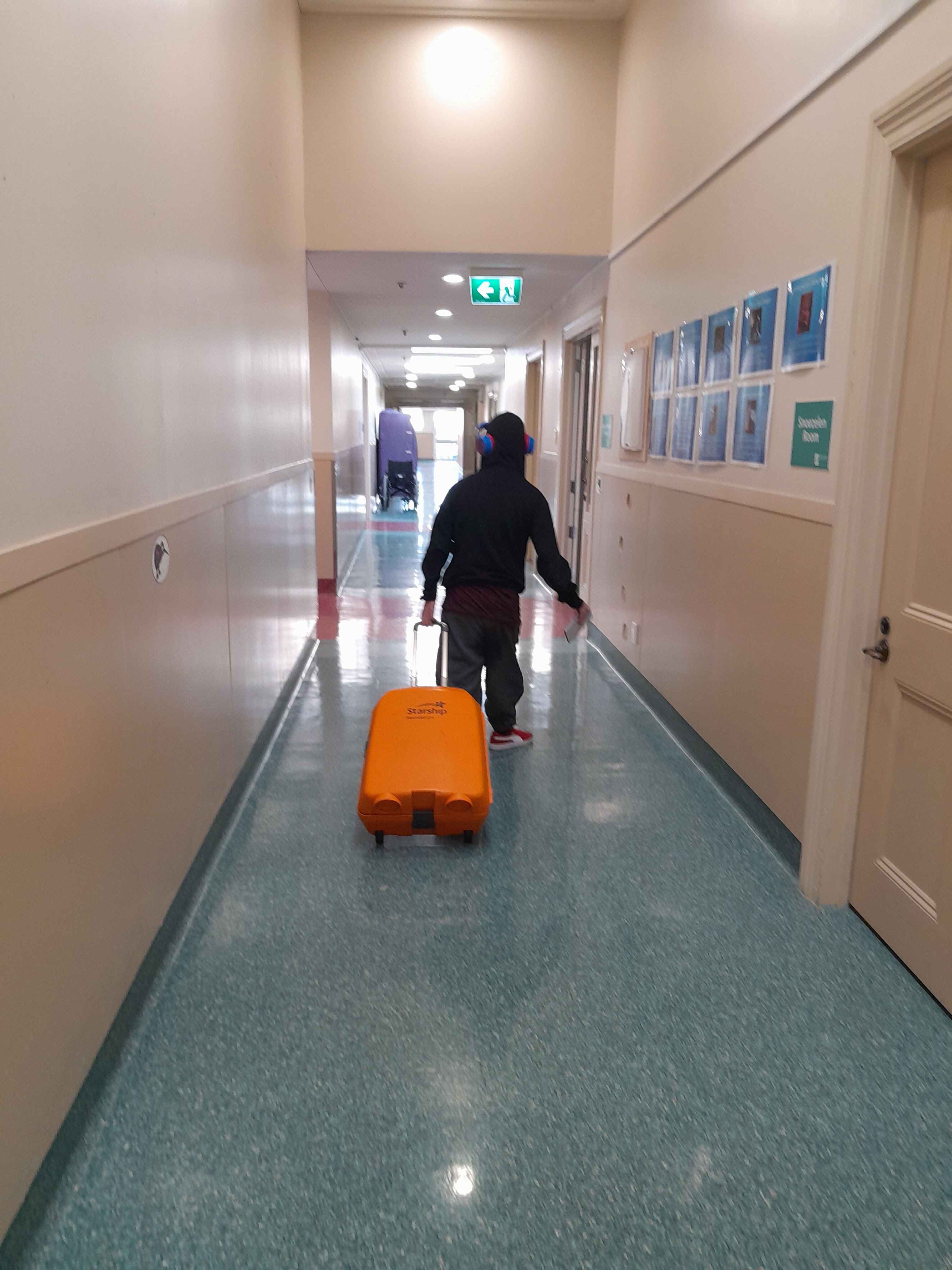
Photo left: In 2024, one of his last stays at Wilson Home, Mitchell heads down the corridor to his room towing his suitcase.
At the end of 2024, when Mitchell turned 21, he was no longer eligible to stay at Wilson Home and there is no alternative place for him to go that offers the same care. This has made 2025, once again, challenging without the breaks in caring.
Respite breaks are what has helped keep our family together. Respite breaks enabled Mitchell to have time away from Mum and Dad, like other children and teens normally have with peers or family. Respite breaks kept my emotional and mental health stable.
There is discussion in the article “you care about me when you care about my son” that facility based respite (like we used) and holiday programmes are the least popular option. I totally understand that viewpoint for those caring for disabled who do not have complex or medical needs. For me, and my family without facility based respite, it is likely we would have had no respite at all. For other family carers who have children or adult children with medical or behavioural needs, alongside physical and/or intellectual disability respite options using family or in home support can be difficult to access – while many do not like out-of-home respite facility based options I can not express how much of a difference this eventually made for our family and Mitchell.
Now that Mitchell has aged out of Wilson Home, we are working hard to find solutions and have used a large portion of respite funding for him to stay in a private respite home, and also we have trialled him staying over at a support workers home. We would like to have options of the carer staying at our home, while he continues his regular schedule and we go away and we would like for him to experience going away without us, while we enjoy our home in peace and quiet. Because of Mitchell’s complex and high needs, our solutions will never be mainstream or cheap and often financially out of reach. But we continue to advocate to have these options. Because the type of respite you use should be something that works for you and the disabled person.
In conclusion, this brings me back to the value and importance of respite. In our case, facility based respite kept our family together because we could recharge – each time we had no respite (early on, Covid, now) we quickly escalated into burnout and my mental health implodes. The value of respite for us, has also been getting time to spend with Mitchell’s sibling on her own. For us, as a husband and wife, to be able to go out and know that Mitchell is cared for and safe. With respite, Mitchell, got regular chances to socialise with others at Wilson Home and to have breaks from his family. This year, as we have struggled to find suitable respite options, we have had to consider Mitchell moving into full time residential care. It’s not really what we want, but without breaks, we simply can’t keep going on as we age.
For others, respite and breaks might look different. It might be their child going to the zoo for the day with a support worker, while they rest. Respite might be uninterrupted sleep. It might be buying a trampoline, meaning their child burns off energy and they get a chance to have a cup of tea. It might be about spending time with other kids. Always, always, always the key element in respite being valuable is having choices that work for each family.
I welcome the reintroduction of flexible funding but this is not enough. In the summary from the Independent Review, family/whanau carers asked for different things – these are available here.5
I would love to hear your thoughts – do you think carers will be supported using the new assessments due to be introduced in 2026? What do you hope for as respite options in the future?
Notes:
- https://carers.net.nz/wp-content/uploads/2018/05/You-care-about-meDBI.pdf
- https://www.disabilitysupport.govt.nz/carers/respite-advice-and-other-resources
- https://www.health.govt.nz/publications/transforming-respite-disability-support-services-respite-strategy-2017-to-2022
- https://www.health.govt.nz/system/files/2018-04/disability-respite-market-new-zealand-apr18.pdf
- https://www.disabilitysupport.govt.nz/disabled-people/changes-to-disability-support-services/summary-findings-from-community-consultation-on-assessment-tools-processes-and-flexible-funding#needs-assessment-and-allocations-should-be-easier-more-consistent-and-streamlined
Cherie
 Yellow Azalea
Thank you for this article about your family and life. Everyone needs to be taught a small amount about Caring for others. So even those in offices and desk jobs know what goes on. Full time Carers should all be trained the same. And families should get the same training to help with caring. As so often so called Carers are not interested in some of the complex cares that are needed. We don’t know what others have to put up with until we walk with others. Or it happens in our family or friends.
LikeLike
@Dorothee it is an issue that there is not more training for paid carers in both medical and behavioural needs. Some paid carers will just opt to work with easier clients and there is no incentive to work with more complex ones.
Perhaps we need to introduce caring into our education system!
LikeLike